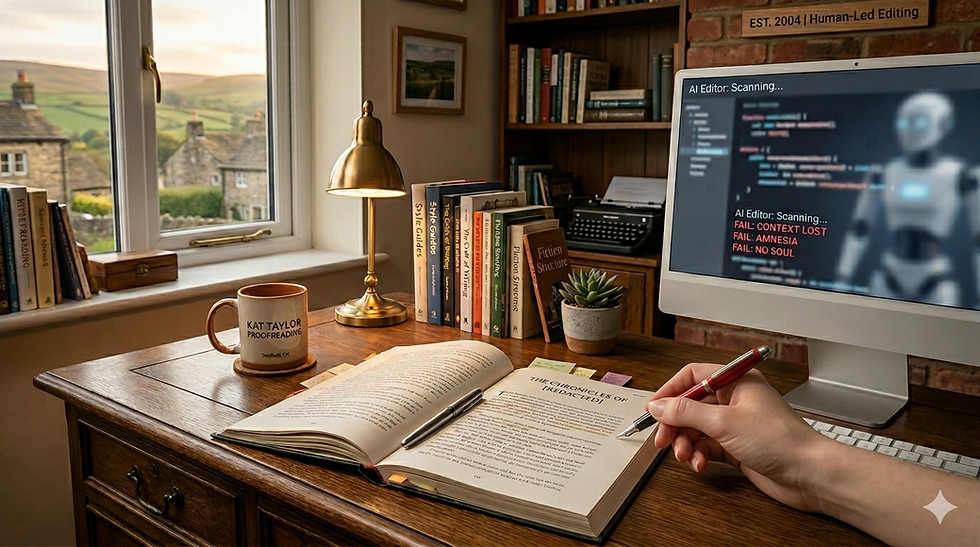
The hidden risks of skipping professional editing for a self-published book

Publishing on Amazon KDP has opened the door for thousands of authors to share their work with the world. With zero upfront fees to upload a manuscript, it is tempting to press 'Publish' as soon as you type the final word.
However, skipping professional editing on a self-published book to save money upfront is often a false economy. While uploading costs nothing, releasing an unedited or poorly polished manuscript incurs a hidden debt paid in lost sales, damaged reviews, and algorithm suppression.
If you are treating your book as a serious investment, here is what really happens when you skip the editorial stage—and why professional polish pays for itself.

1. Automated KDP flags and search suppression
Many authors assume that a few minor typos or formatting glitches will fly under the radar. However, Amazon’s KDP platform relies on automated scans as well as reader report buttons directly inside Kindle eBooks ('Report a Quality Issue').
When readers flag multiple typos, broken formatting, or jarring punctuation errors, Amazon takes notice. Severe quality issues can result in:
Quality warning notices: A public banner placed on your book’s detail page alerting shoppers to formatting or quality issues.
Search suppression: Algorithms quietly lowering your book’s visibility in search results and category browse pages.
A quality flag instantly destroys buyer trust before a potential reader even reads your sample chapter.
2. The brutal impact of 1-star reviews
Modern readers are discerning. They don't just review the subject matter—they review the reading experience. Nothing tanks a new book launch faster than early reviews that state: 'Great concept, but ruined by typos, factual inconsistencies, or poor structure. Needs an editor.'
On Amazon, average star ratings dictate momentum:
Loss of recommendations: Falling below a 4.0-star average means Amazon’s algorithm will stop featuring your book in 'Customers Also Bought' sections.
Wasted ad spend: Running Amazon or Meta ads to a product page with visible complaints about poor editing leads to low conversion rates, meaning you burn through your marketing budget with very little return.
Recovering from a wave of poor launch reviews takes dozens of 5-star ratings to fix—costing significantly more in lost revenue than investing in a professional edit in the first place.
3. Knowing which stage of editing you need for your self-published book
A common mistake self-publishing authors make is hiring the wrong service at the wrong time. Fixing typos won't save a manuscript if the core structure or argument is falling apart, and paying for high-level story advice is wasteful if your draft is still a rough first mess.
Understanding the editing process ensures you spend your budget wisely:
Developmental editing: Focuses on high-level structure, pacing, plot holes, or logical gaps, narrative arc or chapter flow, and overall clarity.
Copyediting: Focuses on paragraph flow, dialogue and tone, sentence structure, consistency, and factual accuracy.
Proofreading: The final safety net before publication, checking for mechanical accuracy, typos, layout consistency, and punctuation errors.
Read More: Not sure which stage your manuscript is currently at? Read my guide on the difference between developmental editing, copyediting and proofreading to pinpoint exactly what your book needs.
4. The 'self-editing' blind spot
Why can't you just edit your own manuscript? The simple answer is human biology.
When you read your own writing, your brain automatically fills in missing words, corrects typos in your head, and skips past awkward phrasing because it already knows what you intended to say. Beta readers, peer reviewers, and family members are fantastic for general feedback, but they read for enjoyment or interest—not for structural pacing, mechanical consistency, and house style.
A professional editor brings trained, objective eyes to spot structural gaps, repetitive dialogue or phrasing, and subtle errors that you are wired to miss.
Quick diagnostic: Is your manuscript actually ready for an editor?
Before handing your draft over to a professional, tick off these essential self-assessment steps to get the most out of your editorial budget:
[ ] Have you finished self-editing? You should have completed at least two or three self-driven drafts to catch obvious plot or structural gaps and typos yourself.
[ ] Have you gathered reader feedback? Beta readers, early reviewers or colleagues should have read the full manuscript to test if the content makes sense to an outside reader.
[ ] Is your word count realistic? Your manuscript fits within standard genre expectations (e.g., sci-fi/fantasy vs. business guide).
[ ] Have you stepped away? You’ve taken at least two weeks away from the manuscript to read it with fresh eyes.
Read more: Want a full breakdown of the pre-editing stage? Check out my complete checklist on When Is Your Book Actually Ready for an Editor? to make sure you're ready to submit.
5. Viewing professional editing as an asset, not an expense
Professional editing is not a vanity tax; it is essential quality control for a product you are asking readers to spend their hard-earned money on.
When you publish a crisp, beautifully polished book, you aren't just selling a single title—you are building a trusted author brand and professional authority. Readers who experience a smooth, professional read are far more likely to leave glowing 5-star reviews, join your mailing list, and buy your next release on day one.
Protect your book’s launch with professional editing
Your book deserves a launch that builds authority and earns the reviews it merits. Before you hit publish on Amazon KDP, ensure your manuscript stands out for all the right reasons.
Ready to prepare your draft for publication? Request a professional manuscript edit today to ensure your book makes the best possible first impression.
About the author
Kat Taylor is a professional proofreader and editor based in the UK, specialising in British English. She works closely with authors preparing manuscripts for submission. Learn more about Kat or explore her proofreading and editing services.